Reproducible results
Call an ordito function twice on the same input on a GPU, and the two results can differ in their
last bits. Thousands of GPU threads add partial sums as they finish, and floating-point addition
depends on order: (a + b) + c is not always a + (b + c). Most of the time the difference is a
unit in the last place and nobody notices. Sometimes it is not: a seeded sampler draws a different
point, a threshold flips, a regression test that compares bytes fails at random.
ordito has one switch for this. With determinism on, every result the setting governs repeats bit for bit from call to call on CUDA. With it off, the default, those results come from the faster arrival-order forms.
import numpy as np

import ordito as od

vertices, faces = od.creation.icosphere(subdivisions=4)
with od.deterministic(True):
    first, _ = od.sample.sample_surface(vertices, faces, 10_000, seed=0)
    second, _ = od.sample.sample_surface(vertices, faces, 10_000, seed=0)
print(np.array_equal(first.numpy(), second.numpy()))  # True
What it looks like
The dragon scan, sampled twice with the same seed on an RTX 5090. With the setting off, a few hundred of the 100 000 samples land somewhere else on the second call, often far from where they were; with it on, none do.
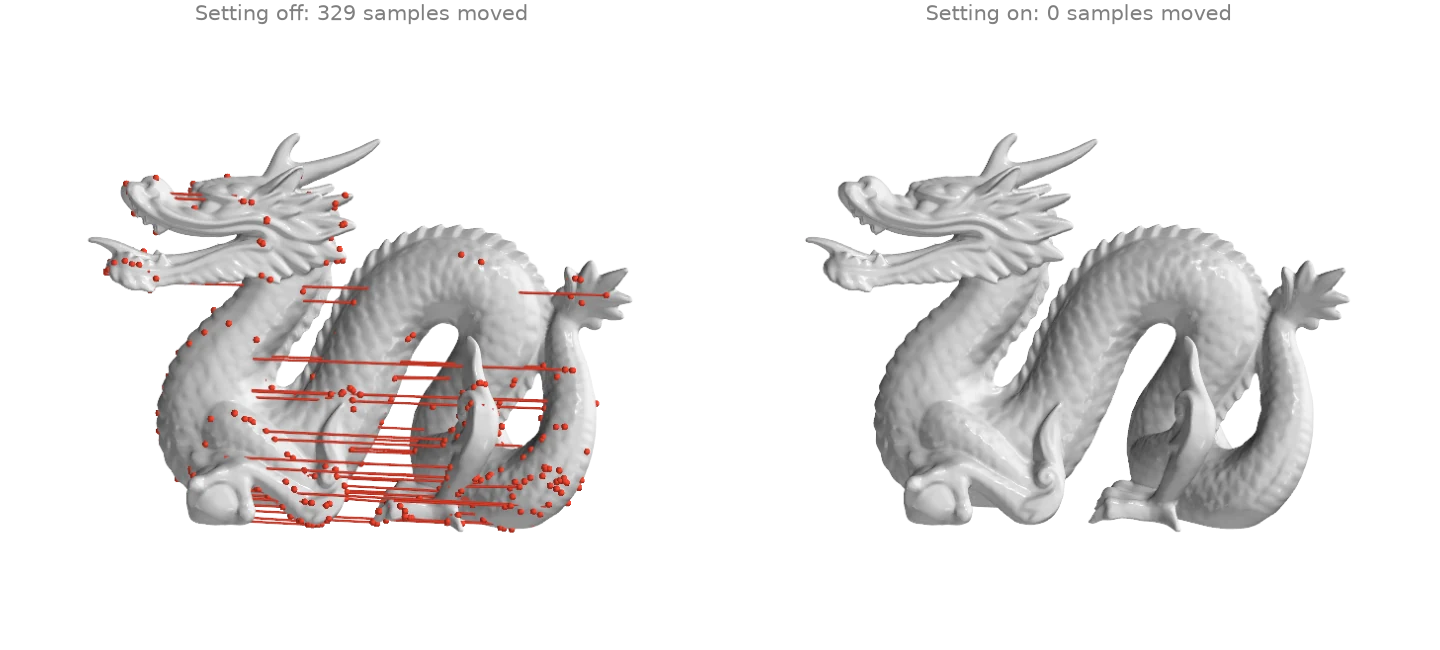
The sampler picks each sample's face by searching a running sum of the face areas. On CUDA that
running sum is a parallel scan whose blocks combine in the order they finish, so a few of its
entries round differently from one call to the next, and a sample drawn right at one of those
entries picks the adjacent face in index order, which on a scan can be on the other side of the
model. The same happens to a plain sum: 64 calls of volume on the
dragon returned 13 different values with the setting off, up to a dozen float32 units in the
last place apart, and one with it on.
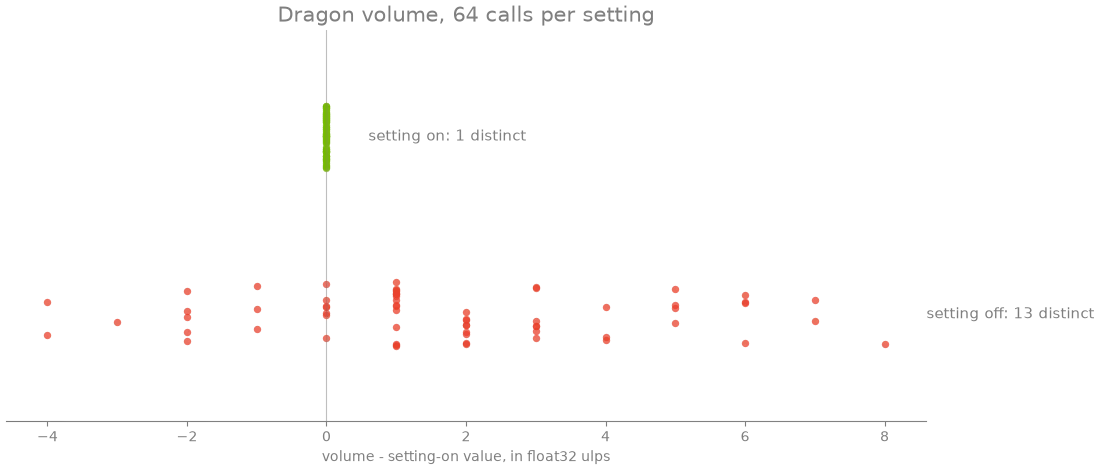
Both figures come from the Reproducible results examples, which have the code.
Turning it on
Three entry points, all in ordito.config and also reachable from the package
itself:
| Call | Scope |
|---|---|
od.set_deterministic(True) |
Process-wide default, seen by every thread and task |
with od.deterministic(True): |
The current thread or asyncio task, until the block exits |
od.is_deterministic() |
Reads the setting in force here |
od.set_deterministic(True)
print(od.is_deterministic())  # True

with od.deterministic(False):
    print(od.is_deterministic())  # False
print(od.is_deterministic())  # True

od.set_deterministic(False)
The context manager nests, restores the previous value on exit even when the block raises, and
wins over the process default for as long as it is active. A task created inside the block
inherits the override; a new thread starts from the process default. There is no per-function
deterministic= keyword: the setting is read when a reduction launches, so it reaches every
reduction a call makes, including the ones inside solvers and loops.
In a test suite
The common pattern is determinism on for every test, so that a comparison of bytes means
something, and off for benchmarks, so that they time what users run. ordito's own suite does
exactly this, in its conftest.py:
import pytest


@pytest.fixture(autouse=True)
def _deterministic_by_default() -> None:
    od.set_deterministic(True)
What it governs
On the CUDA device:
- Floating-point reductions and
float32scans: sums, means, moments and fits, the reductions inside the energies, metrics, measures and registration, the solver loops, and the cumulative sums behind every sampler, arc length and resampling. - Per-group sums of
scatter_sumandsegment_sum, which are then summed exactly in fixed point and rounded once. Their result is identical on the CPU and the CUDA device too. - Per-vertex and per-component sums inside geometry functions: lumped masses, Hessian
energies, vertex defects, the local steps of
arap, loop perimeters and areas, the component volumes and areasrepairdecides on, the positions ofsubdivide_loop,cluster_decimateandisotropic_remesh, and the lattice ofscreened_poisson. - The order of some outputs that are filled through atomic slots: the rows of
vertex_face_adjacency(ascending), the hits ofintersects_location(by ray) and the faces of the polyline triangulations. - Gradients taken with a
wp.Tapethrough the differentiable Chamfer losses.
The complete list, function by function, is in the ordito.config reference.
What it does not govern:
- The CPU device, which runs its blocks one after another and is deterministic either way. Turning the setting on there leaves almost every result unchanged; the reference names the few exact sums whose last bits differ from the plain sum they replace.
- Integer reductions and scans, which are exact in any order.
- Agreement between devices in general. CPU and CUDA results can still differ in the last bits, because the GPU compiler fuses multiplies and adds that the CPU compiler keeps apart. The setting makes each device repeat itself; the exact group sums above are the exception that also agree across devices.
- A few other atomic scatters, such as vertex areas and normals, which stay in arrival order, and repeat anyway because they are summed exactly.
What it costs
The fixed-order forms do more work: a reduction stores one partial per block and adds them in a fixed order, a scan takes a fixed-order tile scan, and an output in a fixed order takes a stable sort. For most calls this is a few microseconds; for a call whose whole job is one of those sorts, it is more. Measured on an RTX 5090, median of 30 interleaved calls, CUDA:
| Call | Off | On | On / off |
|---|---|---|---|
measures.volume, dragon (871 k faces) |
0.044 ms | 0.044 ms | 1.00x |
sample.sample_surface, dragon, 1 M samples |
0.27 ms | 0.28 ms | 1.05x |
remesh.isotropic_remesh, bunny, 3 iterations |
12.5 ms | 12.6 ms | 1.01x |
reduce.scatter_sum, 10 M values into 1 000 groups |
0.68 ms | 0.53 ms | 0.78x |
adjacency.vertex_face_adjacency, dragon |
0.16 ms | 0.39 ms | 2.45x |
The exact group sum can even be the faster one: it avoids the contention of many threads adding into one address. The adjacency rows pay for a stable sort that puts each row in ascending order. In a pipeline, the setting usually costs a few percent.
Caveats
- CUDA graphs keep the mode they were recorded with. A graph captured with the setting off replays the arrival-order kernels after you turn it on. Re-capture after a change.
- Cached state keeps the mode it was built in. A
Trimesh's heat operators and solvers are built once and reused; build them, or the mesh, after setting the mode.Trimesh.vertex_face_adjacencyis the exception: a value cached with the setting off is rebuilt in ascending order the first time it is read with the setting on. - Reproducible is not the same as correct. A result that repeats is not more accurate than one that does not; both are within the rounding error of the algorithm. Turn the setting on for reproducibility (tests, debugging, seeded pipelines, comparing runs), not for precision.