Reproducible results
What the deterministic setting changes, seen on a sampler and on a sum. The Reproducible results page explains the setting.
A seeded sampler, called twice
sample_surface picks each sample's face by searching a CDF
of the face areas, which a float32 scan builds. On CUDA that scan combines its blocks in
arrival order, so with the setting off two calls with the same seed can round a few CDF
entries differently, and a sample drawn next to one of those entries lands on the adjacent
face in index order, which on a scan can be across the model. Inside
deterministic the scan takes a fixed order and the second call
returns the first call's points bit for bit. The red segments join a sample's two positions.
import numpy as np

import ordito as od
from examples import data

vertices, faces = data.load("dragon", device)
pairs = {}
for enabled in (False, True):
    with od.config.deterministic(enabled):
        first, _ = od.sample.sample_surface(vertices, faces, 100_000, seed=7)
        second, _ = od.sample.sample_surface(vertices, faces, 100_000, seed=7)
    moved = np.any(first.numpy() != second.numpy(), axis=1)
    print(f"deterministic={enabled}: {moved.sum()} of 100000 samples moved")
    pairs[enabled] = (first.numpy()[moved], second.numpy()[moved])
deterministic=False: 329 of 100000 samples moved
deterministic=True: 0 of 100000 samples moved
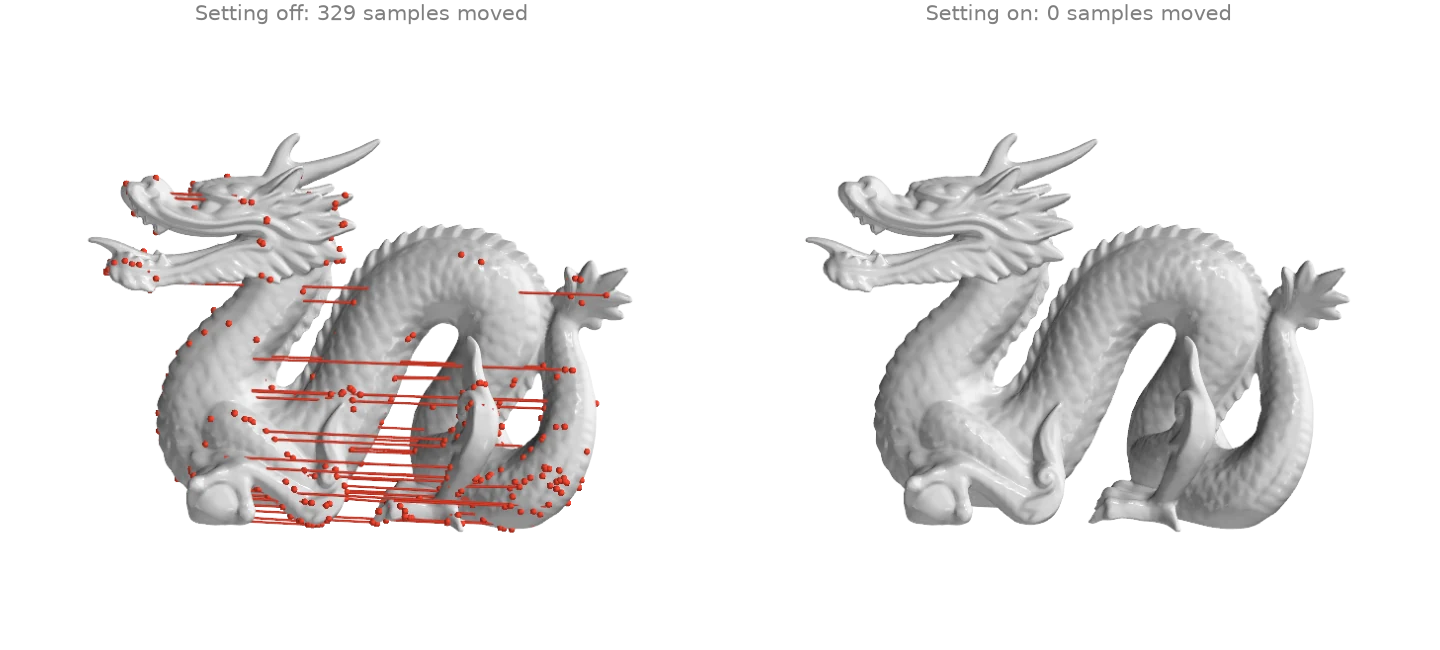
The count of moved points changes from run to run with the setting off; it is zero on the CPU device, which runs its blocks in turn, whatever the setting.
Sums that repeat bit for bit
A floating-point sum depends on the order its terms are added in, and on CUDA the blocks of a
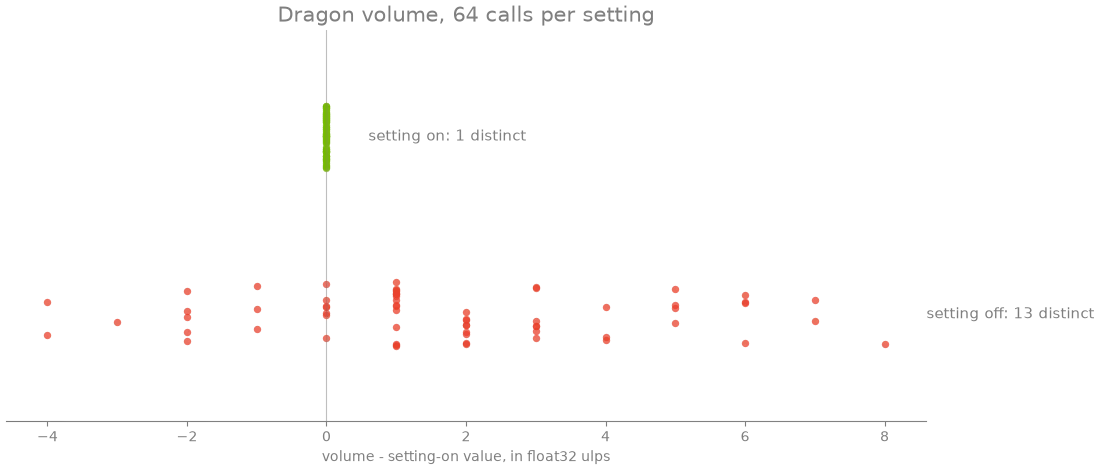
reduction commit in the order they finish. volume of the dragon,
called 64 times with the setting off, returns several values a few float32 units in the last
place apart; with it on, one value. Per-group sums go further:
scatter_sum sums each group exactly in fixed point and rounds
once, so with the setting on its result is also the same on the CPU and the CUDA device.
import numpy as np
import warp as wp

import ordito as od
from examples import data

vertices, faces = data.load("dragon", device)
volumes = {}
for enabled in (False, True):
    with od.config.deterministic(enabled):
        volumes[enabled] = np.array([od.measures.volume(vertices, faces) for _ in range(64)])
    print(f"deterministic={enabled}: {np.unique(volumes[enabled]).size} distinct volumes")

rng = np.random.default_rng(0)
values = rng.normal(size=200_000).astype(np.float32)
groups = rng.integers(0, 16, size=values.size).astype(np.int32)
with od.config.deterministic(True):
    sums = {
        name: od.reduce.scatter_sum(
            wp.array(values, device=name), wp.array(groups, device=name), 16
        ).numpy()
        for name in ("cpu", device)
    }
print("CPU and CUDA group sums identical:", np.array_equal(sums["cpu"], sums[device]))
deterministic=False: 13 distinct volumes
deterministic=True: 1 distinct volumes
CPU and CUDA group sums identical: True