Creating meshes
Primitives, parametric surfaces, sweeps and triangulations from
ordito.creation and ordito.polyline.
Primitive gallery
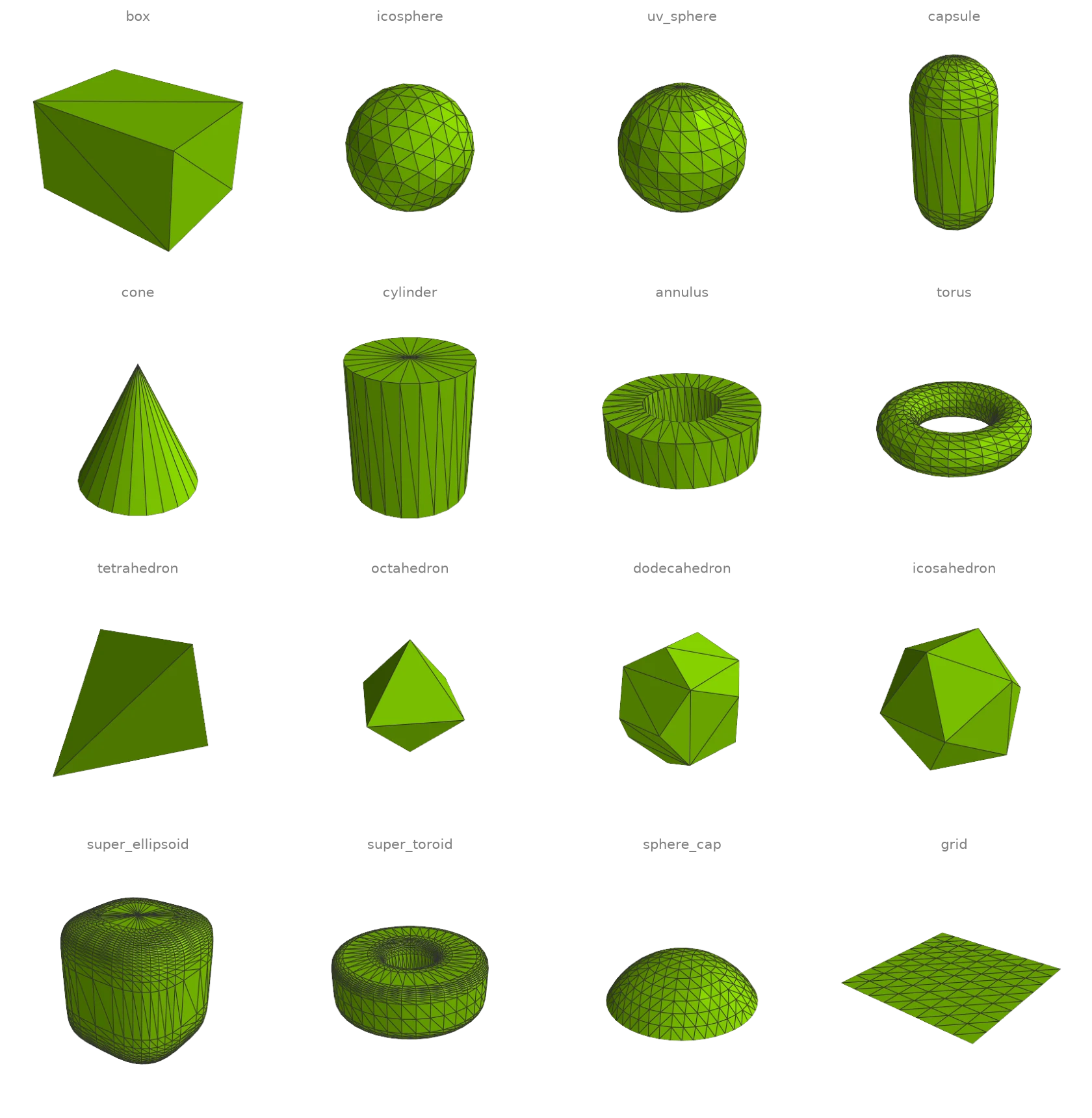
Sixteen builders from ordito.creation, each returning a vertex buffer and
a flat face buffer on the requested device:
box, icosphere,
uv_sphere, capsule,
cone, cylinder,
annulus, torus, the Platonic solids
(tetrahedron, octahedron,
dodecahedron, icosahedron),
the superquadrics super_ellipsoid and
super_toroid, and the two open patches
sphere_cap and grid.
is_watertight confirms which of them are closed.
import math

import ordito as od

c = od.creation
shapes = {
    "box": c.box(extents=(1.6, 1.2, 1.0), device=device),
    "icosphere": c.icosphere(2, device=device),
    "uv_sphere": c.uv_sphere(count=(12, 20), device=device),
    "capsule": c.capsule(height=1.2, radius=0.5, count=(16, 16), device=device),
    "cone": c.cone(0.8, 1.6, sections=24, device=device),
    "cylinder": c.cylinder(0.7, 1.6, sections=24, device=device),
    "annulus": c.annulus(0.5, 1.0, height=0.6, sections=32, device=device),
    "torus": c.torus(1.0, 0.35, 32, 16, device=device),
    "tetrahedron": c.tetrahedron(device=device),
    "octahedron": c.octahedron(device=device),
    "dodecahedron": c.dodecahedron(device=device),
    "icosahedron": c.icosahedron(device=device),
    "super_ellipsoid": c.super_ellipsoid(0.3, 0.6, device=device),
    "super_toroid": c.super_toroid(0.3, 1.0, device=device),
    "sphere_cap": c.sphere_cap(math.pi / 3, subdivisions=3, device=device),
    "grid": c.grid(count=(9, 9), extents=(2.0, 2.0), device=device),
}
closed = [name for name, (v, f) in shapes.items() if od.validation.is_watertight(v, f)]
print(f"{len(closed)} of {len(shapes)} are watertight")
print("open:", ", ".join(name for name in shapes if name not in closed))
14 of 16 are watertight
open: sphere_cap, grid
Modelled on: trimesh: creation · Open3D: mesh primitives · PyVista: geometric objects
Parametric surfaces
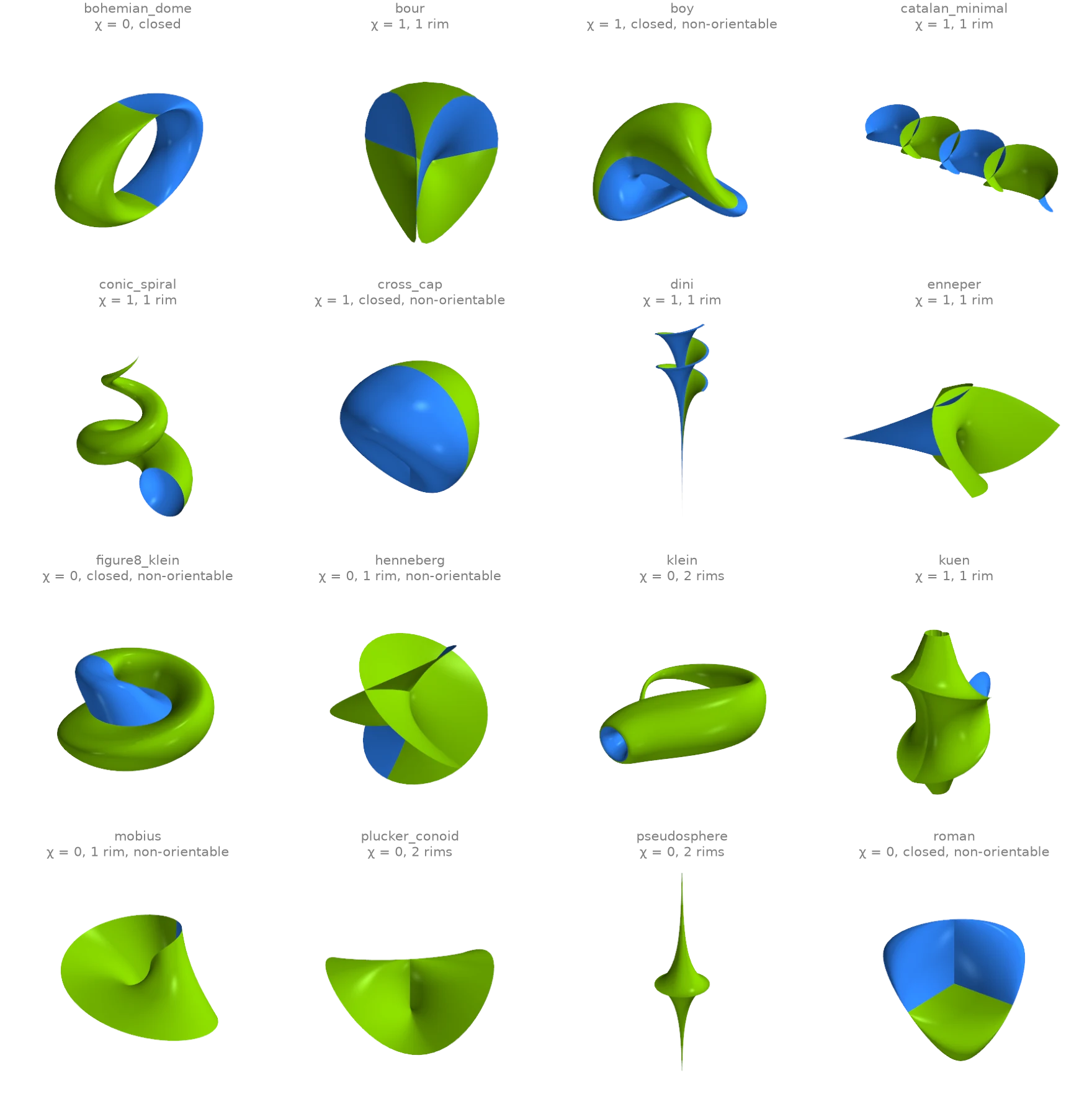
parametric_surface samples sixteen classical surfaces:
minimal surfaces, surfaces of revolution and immersions of non-orientable ones. Seams and poles
are glued in the index buffer, so the topology is exact at any resolution: a
Trimesh reports the Euler characteristic, the number of boundary loops
and whether the surface is orientable. Each face is coloured by the side that faces the
camera, green for the front of its winding and blue for the back. On a non-orientable surface
the two colours meet along a seam that no consistent winding can remove.
import ordito as od

kinds: list[od.creation.ParametricSurfaceKind] = [
    "bohemian_dome", "bour", "boy", "catalan_minimal", "conic_spiral", "cross_cap",
    "dini", "enneper", "figure8_klein", "henneberg", "klein", "kuen",
    "mobius", "plucker_conoid", "pseudosphere", "roman",
]  # fmt: skip
surfaces = {}
for kind in kinds:
    surfaces[kind] = od.Trimesh(*od.creation.parametric_surface(kind, 80, 80, device=device))
closed = [k for k, m in surfaces.items() if not m.boundary_loops]
print("closed:", ", ".join(closed))
print("non-orientable:", ", ".join(k for k, m in surfaces.items() if not m.is_orientable))
closed: bohemian_dome, boy, cross_cap, figure8_klein, roman
non-orientable: boy, cross_cap, figure8_klein, henneberg, mobius, roman
Modelled on: PyVista: parametric objects
Revolve, extrude and sweep
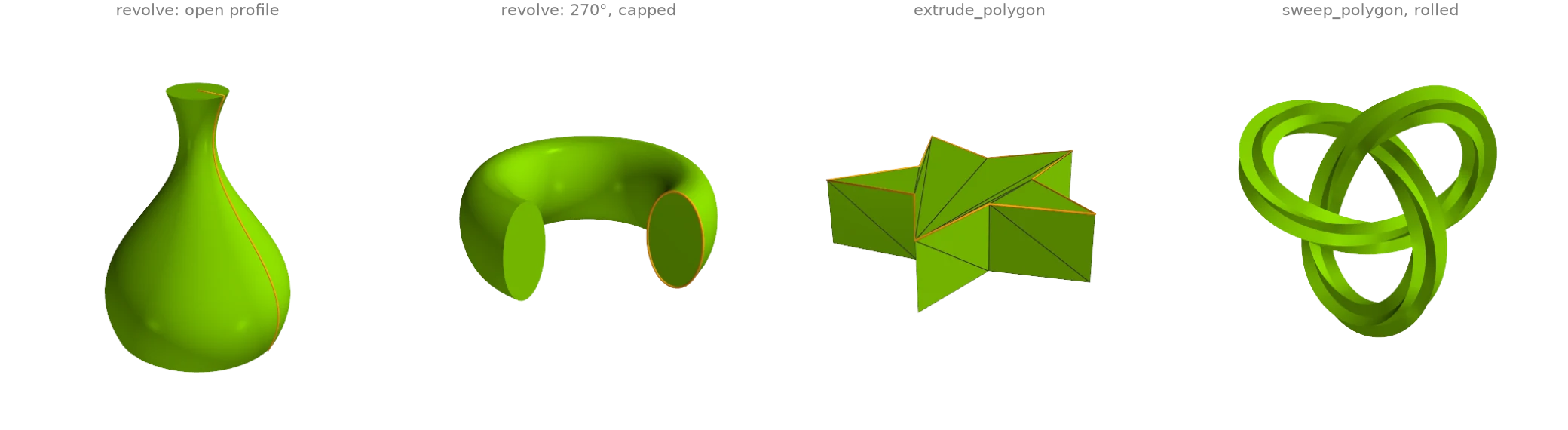
Three ways to turn a 2-D outline into a solid.
revolve spins a profile about the Z axis: an open profile that
starts and ends on the axis gives a closed vase, and a closed section revolved through part
of a turn gets capped ends.
extrude_polygon triangulates a star and raises it into a
prism. sweep_polygon carries the
same star along a trefoil knot, rolling it twice around the path's tangent on the way.
import numpy as np
import warp as wp

import ordito as od

def vec2(points: np.ndarray) -> wp.array[wp.vec2]:
    return wp.array(points, dtype=wp.vec2, device=device)

# A vase: radius against height, from the axis at the bottom to the axis at the top.
height = np.linspace(0.0, 2.0, 40)
radius = 0.55 + 0.25 * np.sin(2.6 * height + 0.6) - 0.1 * height
profile = np.concatenate([[[0.0, 0.0]], np.stack([radius, height], 1), [[0.0, 2.0]]])
vase = od.creation.revolve(vec2(profile), sections=64)

# A closed section revolved through three quarters of a turn, with capped ends.
t = np.linspace(0.0, 2.0 * np.pi, 48, endpoint=False)
section = np.stack([1.0 + 0.3 * np.cos(t), 0.5 * np.sin(t)], 1)
ring = od.creation.revolve(vec2(section), angle=1.5 * np.pi, cap=True, sections=48)

angle = np.linspace(0.0, 2.0 * np.pi, 10, endpoint=False)
radii = np.where(np.arange(10) % 2, 0.45, 1.0)
star = np.stack([radii * np.cos(angle), radii * np.sin(angle)], 1)
prism = od.creation.extrude_polygon(vec2(star), 0.5)

s = np.linspace(0.0, 2.0 * np.pi, 301)
knot = np.stack(
    [np.sin(s) + 2 * np.sin(2 * s), np.cos(s) - 2 * np.cos(2 * s), -np.sin(3 * s)], 1
)
swept = od.creation.sweep_polygon(
    vec2(0.45 * star),
    wp.array(knot, dtype=wp.vec3, device=device),
    angles=wp.array(np.linspace(0.0, 4.0 * np.pi, 301), dtype=wp.float32, device=device),
)
for name, (v, f) in [("vase", vase), ("ring", ring), ("prism", prism), ("knot", swept)]:
    print(
        f"{name:>5}: {f.shape[0] // 3:5d} faces, watertight {od.validation.is_watertight(v, f)}"
    )
 vase:  5120 faces, watertight True
 ring:  4700 faces, watertight True
prism:    36 faces, watertight True
 knot:  6000 faces, watertight True
Modelled on: trimesh: creation · PyVista: extrude rotate · MeshLib: extrude
Polygon triangulation
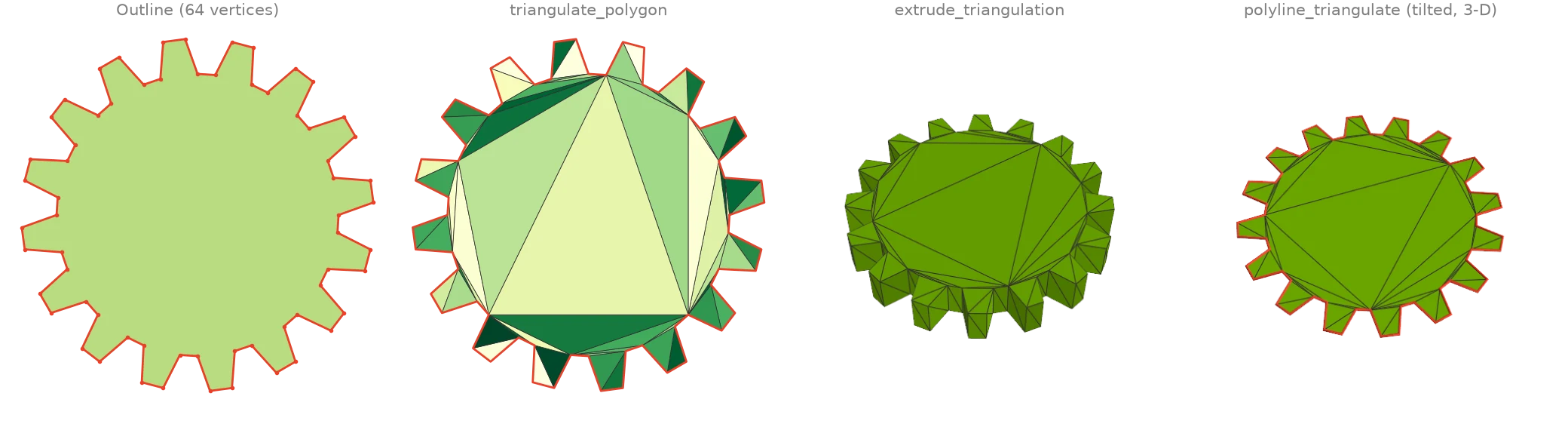
triangulate_polygon fills a simple 2-D polygon by ear
clipping on the device, using only the polygon's own vertices: an n-gon becomes n - 2
triangles. extrude_triangulation raises the
triangulation into a watertight solid, and
polyline_triangulate does the same filling for a
closed planar loop in 3-D, whatever plane it lies in. Interior rings (holes) are not
supported, so the gear's bore is left out.
import numpy as np
import warp as wp

import ordito as od

# A 16-tooth gear outline, counter-clockwise.
teeth, steps = 16, np.array([0.0, 0.18, 0.5, 0.68])
angle = 2 * np.pi * (np.arange(teeth)[:, None] + steps).ravel() / teeth
radius = np.tile([0.8, 1.0, 1.0, 0.8], teeth)
outline = np.stack([radius * np.cos(angle), radius * np.sin(angle)], axis=1)

ring, faces = od.polyline.triangulate_polygon(wp.array(outline, dtype=wp.vec2, device=device))
print(f"{ring.shape[0]} vertices -> {faces.shape[0] // 3} triangles")
solid = od.creation.extrude_triangulation(ring, faces, height=0.3)
print(f"extruded: watertight {od.validation.is_watertight(*solid)}")

# The same outline on a tilted plane in 3-D.
tilt = od.transform.matrix_to_numpy(od.transform.rotation_matrix((1.0, 1.0, 0.0), 0.9))[:3, :3]
loop = np.c_[outline, np.zeros(len(outline))] @ tilt.T
loop_faces = od.polyline.polyline_triangulate(wp.array(loop, dtype=wp.vec3, device=device))
print(f"tilted loop: {loop_faces.shape[0]} triangles")
64 vertices -> 62 triangles
extruded: watertight True
tilted loop: 62 triangles
Modelled on: libigl 604 · MeshLib: contour triangulation · trimesh: creation
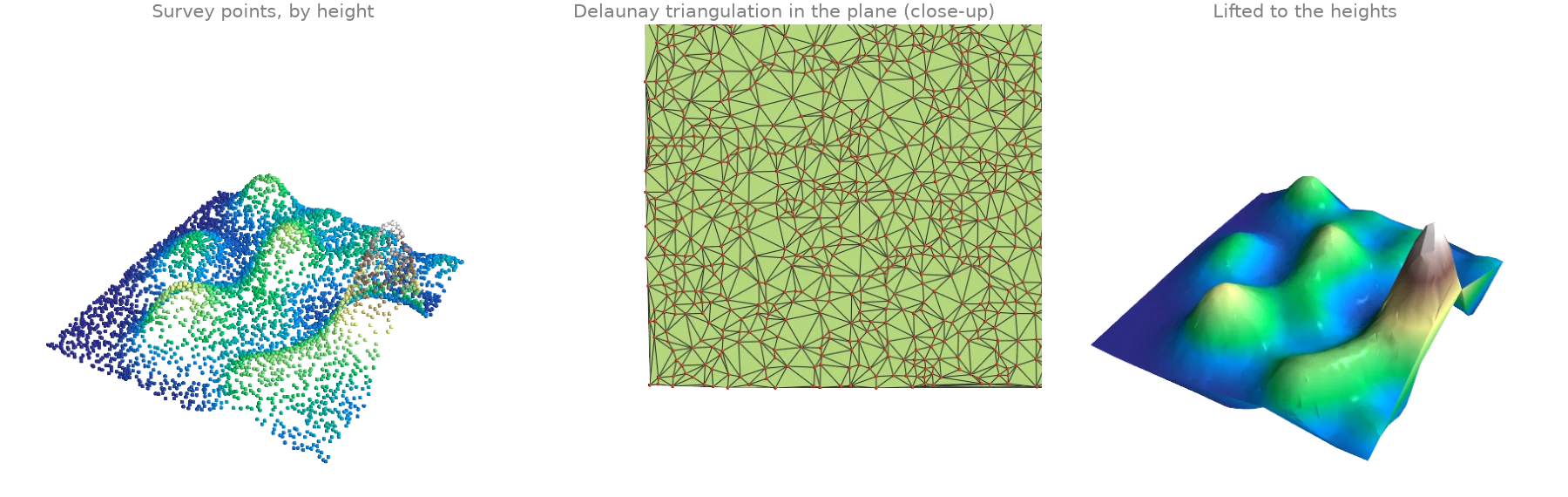
Terrain triangulation
Scattered survey points of a height field are triangulated in the plane by
delaunay_triangulation, which returns the
triangulation that maximizes the smallest angle. Its faces index the input points, so lifting
them back to their heights turns the 2-D triangulation into the terrain surface (a 2.5-D
mesh).
import warp as wp

import ordito as od
from examples import data

points = data.load_points("terrain_points", device)
plan = wp.array(points.numpy()[:, :2], dtype=wp.vec2, device=device)
faces = od.reconstruction.delaunay_triangulation(plan)
terrain = od.Trimesh(points, faces)
print(f"{points.shape[0]} points -> {terrain.n_faces} triangles")
print(f"boundary loops: {len(terrain.boundary_loops)}, Euler {terrain.euler_characteristic}")
4000 points -> 7973 triangles
boundary loops: 1, Euler 1
Modelled on: PyVista: delaunay_2d · MeshLib: terrain triangulation